


PA6-CF
Tax excluded. Actual tax rate varies by region.



Couldn't load pickup availability


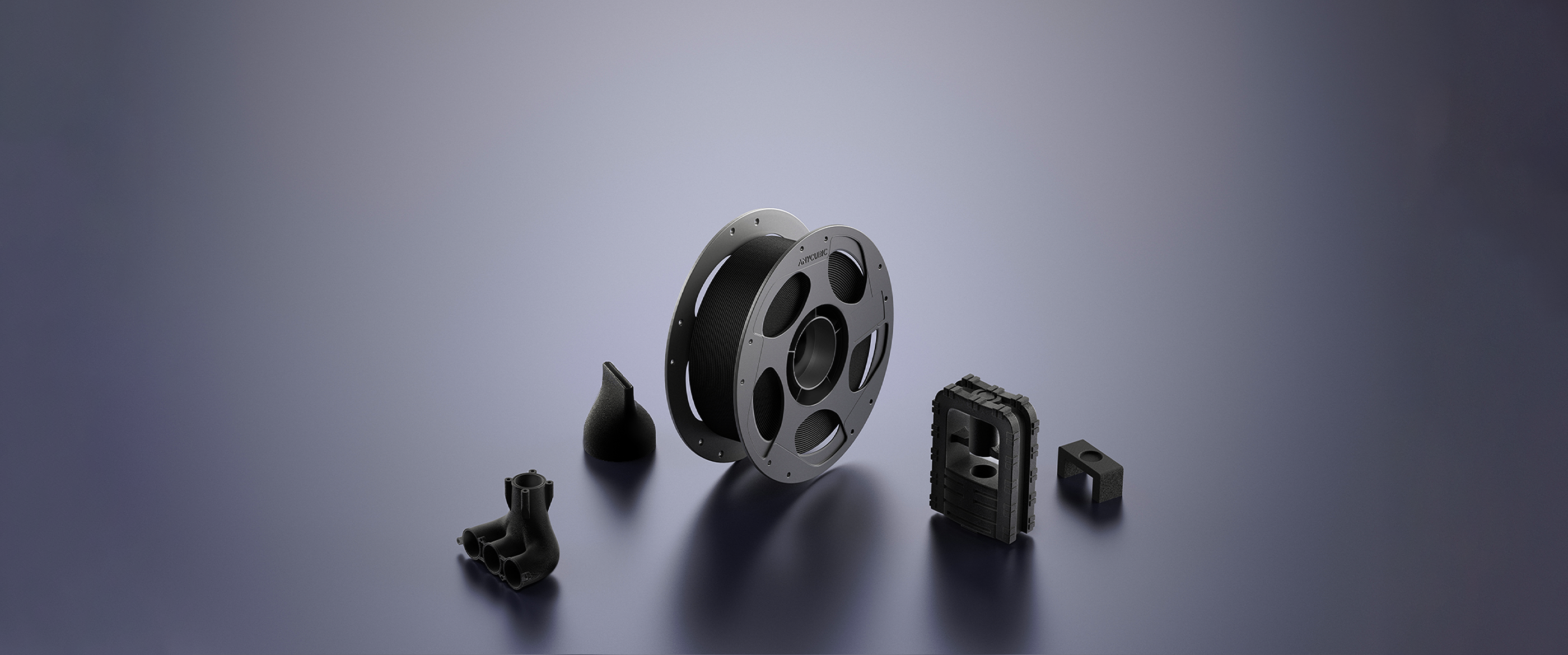


215℃ Heat Resistance
With a heat resistance of 215℃, the Anycubic PA6-CF filament offers superior performance for high-temperature applications such as motor covers, pan handles, and kettle bases.

Highly Resilient against Impact
Anycubic PA6-CF combines exceptional wear resistance with the resilience needed for high-impact applications. From RC chassis and suspension to custom bicycle parts.

Industrial-Grade Toughness
The Anycubic PA6-CF pushes far beyond the stress limits of standard ABS. Prints maintain extreme dimensional accuracy and deformation resistance even under heavy loads. The definitive choice for structural parts, fixtures, and precision jigs.
Warp Resistant
Reinforced with 20% carbon fiber, this filament naturally resists internal stress to virtually eliminate warping. Providing higher success rate and lower material costs for every project.


Premium Matte Finish
Parts printed with Anycubic PA6-CF feature a natural matte finish and a distinct carbon fiber texture. Achieve a premium aesthetic straight off the build plate—no extensive post-processing required.

Reusable Filament Spool
The reusable filament spool incorporates a threaded connection system engineered for enhanced stability when paired with spool-free filaments. This design significantly reduces the risk of entanglement, filament scattering, and operational errors.
*You can keep the spool for future use - saving costs and minimizing waste with every refill.
Filament Installation

1. Label the Filament

2. Load the Filament

3. Locking the Spool

4. Prepare the Filament
File Download
Precautions
- The filament must be thoroughly dried before printing. Recommended drying conditions: 90–100°C in a forced-air convection dryer for 8–12 hours; or on a printer heatbed at 90–100°C for approximately 12 hours (turn over halfway through).
Caution: Do not exceed 100°C to avoid deformation or damage to the spool. - PA6-CF is highly sensitive to moisture in the air. It must be kept dry both during printing and storage. It is recommended to store the filament in a sealed dry box, aluminum foil sealed bag, or other airtight container.
- It is recommended to remove supports within 2 hours after printing is complete, as the material becomes tougher after absorbing moisture, making removal difficult. If the part has already absorbed moisture, re-dry it before removing supports.
- PA6-CF must be printed in an fully enclosed chamber. It is not suitable for open-frame bed slinger 3D printers.
- After absorbing moisture, the strength and stiffness of PA6-CF will noticeably decrease, but its toughness will significantly increase, making it suitable for models that require high toughness and elasticity. To suppress the strength loss caused by moisture absorption, you can apply a moisture-blocking coating such as paint or wax to the surface of the model.
- Annealing the printed model in a forced-air convection oven at 80–120°C for 6–16 hours can significantly improve its strength and stiffness. The annealing effect is influenced by the model's structure, size, and annealing conditions; some models may experience warping or deformation.
Caution: When drying the filament or annealing the model, use a forced-air convection oven with uniform temperature distribution and a sufficiently large interior volume. Keep items away from direct proximity to heating elements. Never use a microwave oven or household kitchen oven, as this may damage the filament, spool, or model.


